“Teacher, where do you live?” Jesus replied: “Come, and you will see”. Jn 1: 38-39
The process of discerning a vocation takes the form of a dialogue between one’s conscience and the Lord Jesus. Through the action of the Holy Spirit, deep within our heart, we begin gradually to recognise, to interpret, and to choose our calling.
The first stirrings of a vocation are nourished by a regular life of prayer, especially in silence; frequent reception of the sacraments, especially the Holy Eucharist and confession; prayerful reading of the Word of God; and openness to a spiritual director or a trusted priest.
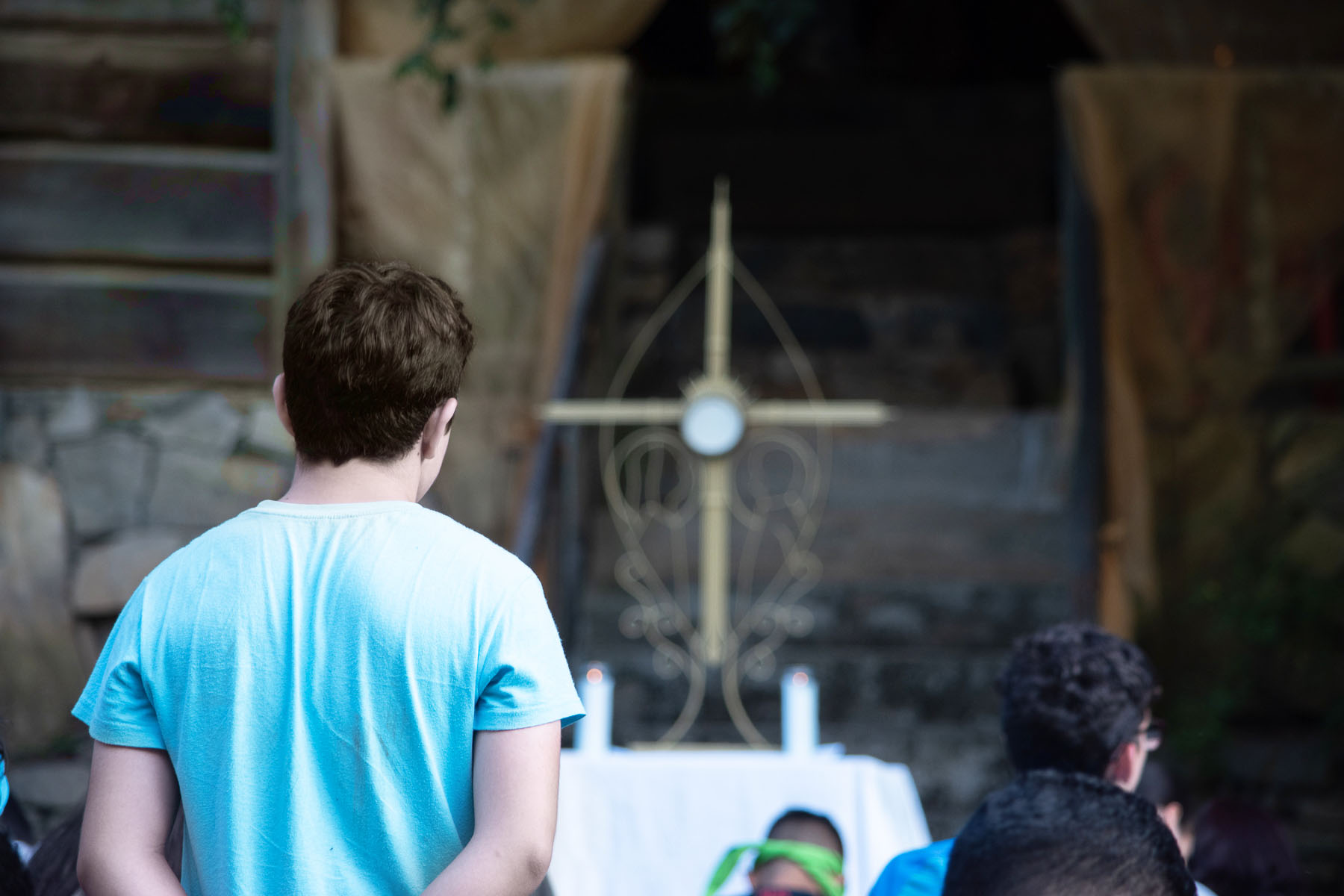
“That life was made visible; we saw it and are giving our testimony”
1 John 1:2
Our charism takes its inspiration from the figure and writings of the disciple Saint John. It is summed up in the following words: Like the apostle John, living together as friends of Christ and witnessing to his light and his love.
We serve the Church by living a life of consecration and of brotherly communion with a view to mission, in the footsteps of Christ who was chaste, poor and obedient. Our charism is characterised by communal prayer and fraternal charity, lived out in small priories.
Our charism is lived concretely in our religious life through four essential pillars: prayer, fraternity, study and mission.
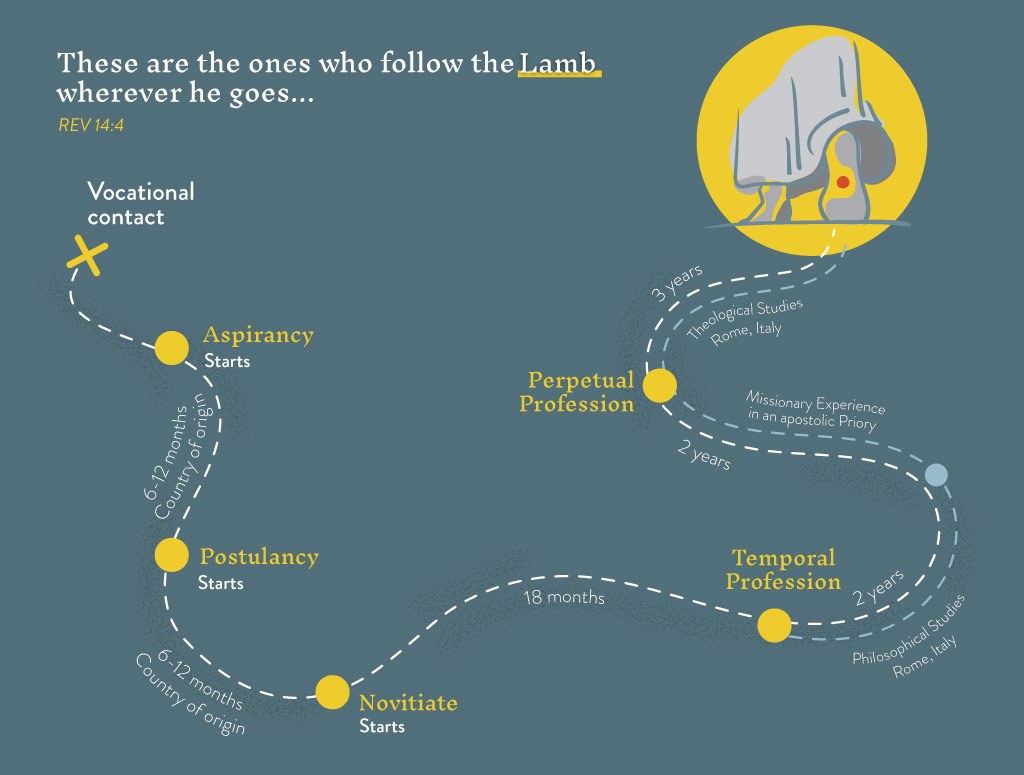
Entire Process for Joining
The first step is Aspirancy. This preparatory stage is to help you grow and discern, both humanly speaking and in your Christian life; to discover what religious life is and the charism of our community; and to see if our way of consecrated life suits you. While following this program, which lasts for 6 to 12 months, the candidate continues his job or his studies. Once the Aspirancy Program is concluded, and if the discernment is positive on both sides, the Community admits the young man to participate in the life of the Brothers. Postulancy then begins, which lasts from 6 to 12 months. During that time means are provided to prepare the postulant to enter the Community. Having proved his vocation from within community life, the postulant can apply to become a novice.
In the Community of Saint John, the Novitiate lasts eighteen months. It is the initiation period. Six months after entering, the novice receives the habit. At the end of the novitiate, the Brother commits himself through the vows of poverty, chastity and obedience for four years, called Temporal Profession. By this stage, the discernment has already begun as to whether the brother has a calling to the sacred priesthood as part of his religious life or not.
Then begins a period that combines philosophical and theological study with an experience of apostolate, leading towards Perpetual Profession, a commitment for one’s whole life. After perpetual profession and a further time of theological study, and then ordination to the priesthood for those called to it, brothers are sent to begin their apostolic life in priories.
Testimony
Discover a few testimonies on the institutionnal website of the Brothers of Saint-John.
Delve a little deeper
CONTACT US
Are you a young man living in Europe and wondering whether God may be calling you to religious life?
If you have any vocational concerns or any other questions about the Vocational Process or the Community, please write to the Postulant Director, Brother John Luke
brjohnluke@stjean.com
OR CONTACT THE PRIORY OF YOUR CHOICE
Austria
Archdiocese of Vienna
Hauptplatz 26 A – 2293 – Stadt Marchegg, Austria
+ 43 2285 7360
brueder@johannesgemeinschaft.at
www.johannesgemeinschaft.at
Belgium
Diocese of Liège
Rue de la Sapinière, Watermael-Boitsfort, Belgium
+ 32 (0)4360-01-29
freres@stjean-banneux.com
www.stjean-banneux.com
England
Diocese of Brentwood
56 St. Anthony’s Road E7 9QB London
+ 44 20 84 72 04 33
london@stjean.com
isjlondon.com
Italy
Diocese of Rome
Largo Febo, 17 00186 Roma, Italy
+ 39 06 68 13 45 63
rome@stjean.com
Lithuania
Archdiocese of Vilnius
Antakalnio g. 27 LT-10312 Vilnius, Lithuania
+ 370 671 32 712
vilnius@joanitai.org
www.joanitai.org
Netherlands
Diocese of Utrecht
Vleutenseweg 517, 3532 HK Utrecht, NL
+ 31 30 293 1474
utrecht@stjan.org
stjan.org//nl/broeders-utrecht.html
Romania
Archdiocese of Bucharest
Str. Jiului 37, sect. 1 013211 Bucuresti 1
+ 40 21 668 5919
bucarest@stjean.com
www.manastireasfantafamilie.ro
Switzerland
Diocese of Lausanne, Geneva and Fribourg
Rue des Voisins 23, 1205 CH-1205 Geneva
+ 41 22 708 10 00
geneve@stjean.com
www.stfrancois-ge.ch
Frequently Asked Questions
Are you brothers or priests?
The heart of our vocation is our consecration to the Lord through religious profession in the footsteps of Saint John. The priesthood, which the majority of brothers receive, is therefore received within that consecration. A brother who is also a priest seeks, like Saint John, to be a friend and apostle of the Lord at the service of the Church.
If a brother in formation discerns a call to the priesthood, and if he meets the required conditions, then he will be ordained a priest for the service of God and his Church. This discernement takes place before the perpetual profession. A brother who is not a priest is nevertheless fully a brother through his religious profession. He has a ‘voice in chapter’ just like the others and participates in the apostolic mission of the community.
Which type of community are the Brothers of Saint John?
Why Saint John as patron saint?
In John’s footsteps we wish to follow the Lamb and dwell with him. To follow Jesus as Saint John did also requires that we become disciples who live in personal friendship with Jesus, keeping his commandments, and in particular that of brotherly love. Together with John we receive Mary as our Mother at the Cross; she is the one who teaches us how to be faithful to our calling each day (Charism, 2.4)
What do the vows of poverty, chastity and obedience mean?
They are the means given to us by the Church to consecrate ourselves to the Holy Trinity and to live in the footsteps of Christ who was chaste, poor and obedient.
What do you do? What type of apostolate do you carry on?
We desire to be engaged in the evangelical mission of the Church. The apostolates vary according to the needs of the local churches, always with an emphasis on faith formation.
What do your spirituality look like? Your way of praying?
We have received God’s call to follow Christ in the spirit of the beloved disciple, Saint John the Evangelist. Our days are punctuated by times of community silent prayer which is is at the heart of our vocation and of its renewal. The celebration of the Mass is the source and summit of our day and extends into daily community Eucharistic adoration. The celebration in common of of the divine hours nourishes our relationship with Christ, connects us to the prayer of the Church, and builds up our brotherly communion.” (Charism, 2.11)
Why focus on fraternity life?
John in his 1st Letter assures us that whoever loves God, must also love his brother (1Jn 4:21). We seek to allow our relationship with Christ to grow into brotherly communion. We thus hope to witness to the charity to which God invites us and all people, this charity which becomes reality in the mystery of the Church. (Charism, 9)
Why focus on formation?
Today’s world, secularised and disorientated, poses complicated challenges. We hear the call to be consecrated in the Truth. This means offering Jesus our whole person, and seeking the truth in all areas of our lives, from study to community life and apostolate. We desire to share the search for wisdom with all those we meet. (Charism, 5.8)
Is there an age limit to join?
What happens if I am a seminarian or a member of another community?
It would be necessary for us to ask your formator for a letter of recommendation. Contact a brother and discuss your concerns with him.
Do you admit women?
No. But within our religious family, there are two women’s congregations: the Contemplative Sisters of Saint John and the Apostolic Sisters of Saint John who live a life very similar to ours.